US Currency Market Intelligence Report: October 29, 2026
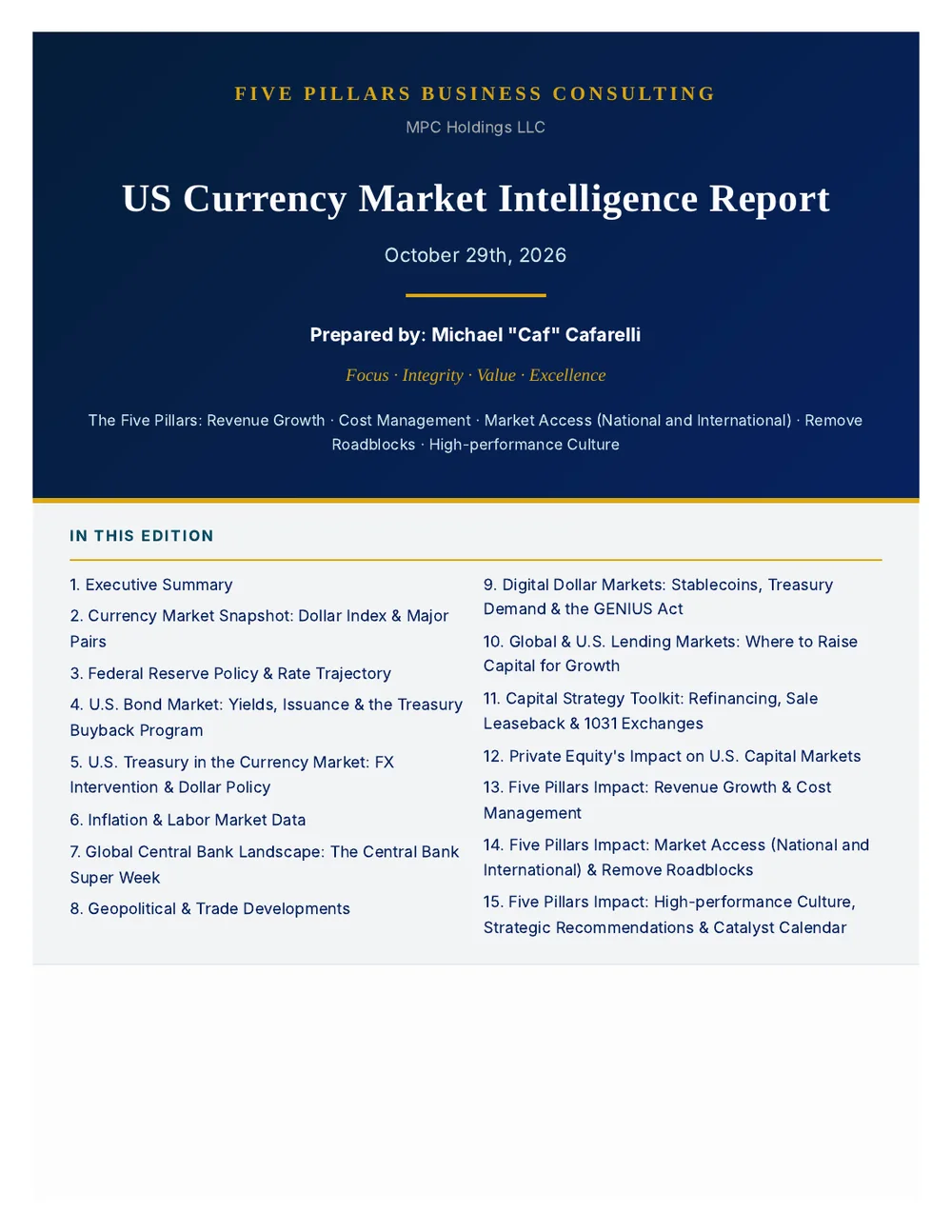
The Fed held at 3.75% to 4.00% on October 28th, but both dissents favored a hike, and December hike odds jumped to 87.5%. A 20-page report on the dollar, rates, bonds, central banks, and what it means for financing decisions before the December 8th and 9th FOMC meeting.
By Michael Cafarelli
Download the report (PDF, 20 pages)
On October 28th the Fed held rates, but the substance was hawkish: two FOMC members voted for a hike that didn't happen, and markets now assign an 87.5% probability to one in December.
- 3.75–4.00%Fed funds target range, held 10–2 on October 28th (both dissents favored a hike)
- 87.5%CME FedWatch December hike odds, up from roughly 73% the day before
- 102.14ICE U.S. Dollar Index after the FOMC statement, up 0.13% since October 14th
- 5.05%10-year Treasury yield after the FOMC statement, down from 5.36% on October 12th
Executive summary
The two weeks since our last edition delivered a genuine "central bank super week" and a Federal Reserve decision that was simultaneously a hold and a hawkish statement. On October 28th, the FOMC kept the federal funds target range at 3.75% to 4.00% by a 10–2 vote, but the two dissents, from Governor Lisa Cook and Cleveland Fed President Beth Hammack, both favored a 25 basis point hike, not a cut. Chair Kevin Warsh's statement dropped forward guidance entirely and upgraded the economy's description from "solid" to "expanding at a strong pace."
That decision was one of five major central bank meetings compressed into a 72-hour window. The Reserve Bank of New Zealand hiked to 3.00%, the Bank of Canada held at 2.25%, and the European Central Bank held its deposit rate at 2.50% on October 29th even as Eurozone inflation has risen to 3.8%. The Bank of Japan decides October 30th. ECB President Christine Lagarde also announced she will step down on February 7th, 2027, pushing the French 10-year yield above 5% for the first time since 2002.
The long end of the Treasury curve has pulled back from the 24-year highs set in early October: the 30-year closed at 5.31% on October 26th after touching 5.73% on October 12th, and the 30-year fixed mortgage rate eased to 7.32%, its first down week since early September. The dollar was mixed rather than directional: the euro and sterling firmed against it while USD/JPY and USD/CAD moved lower.
The practical read: the record-setting phase of this cycle has paused, and modest relief is real and welcome. But the Fed's decision was a hold in name only. Use this pause to lock in financeable decisions before the December 8th and 9th FOMC meeting, not to treat the pullback in yields as the start of a sustained easing cycle.
Strategic recommendations
- Treat the October 28th decision as a hawkish signal despite the headline hold, and lock in any financeable variable rate exposure before the December 8th and 9th FOMC meeting.
- Use the pullback in Treasury yields and the mortgage rate's first down week in seven as a window to execute refinancing or sale leaseback decisions already under consideration, rather than waiting for further easing that is not the Fed's stated base case.
- Build the January 18th, 2027 GENIUS Act compliance deadline into any stablecoin- or digital-payments-adjacent planning now.
- Keep the January 1st, 2027 Canada automotive tariff deadline in contingency and contract-renegotiation planning for any Canada-exposed business.
- Track the ECB leadership transition and French sovereign bond stress as a distinct European risk factor for any Eurozone exposure.
- Watch the October 30th Bank of Japan decision as the next test of whether the yen's modest firming is durable.
Catalyst calendar
| Date | Event |
|---|---|
| Oct 30, 2026 | Bank of Japan rate decision (hold widely expected) |
| Nov 4, 2026 | Treasury Quarterly Refunding, buyback size update |
| Dec 8–9, 2026 | FOMC meeting (about 87.5% hike odds) |
| Dec 11, 2026 | Government funding (continuing resolution) deadline |
| Jan 1, 2027 | U.S. 50% automotive tariff on Canadian goods takes effect |
| Jan 18, 2027 | GENIUS Act full compliance deadline (OCC rule finalized Oct 21) |
| Feb 7, 2027 | ECB President Christine Lagarde's planned departure |
Inside the 20-page report
Executive Summary · Currency Market Snapshot: Dollar Index & Major Pairs · Federal Reserve Policy & Rate Trajectory · U.S. Bond Market: Yields, Issuance & the Treasury Buyback Program · U.S. Treasury in the Currency Market: FX Intervention & Dollar Policy · Inflation & Labor Market Data · Global Central Bank Landscape: The Central Bank Super Week · Geopolitical & Trade Developments · Digital Dollar Markets: Stablecoins, Treasury Demand & the GENIUS Act · Global & U.S. Lending Markets: Where to Raise Capital for Growth · Capital Strategy Toolkit: Refinancing, Sale Leaseback & 1031 Exchanges · Private Equity's Impact on U.S. Capital Markets · Five Pillars Impact sections and the full catalyst calendar.
Full source citations are in the PDF. The next edition is due November 12, 2026.
Want this analysis applied to your financing and capital decisions? Get in touch.
More from the blog
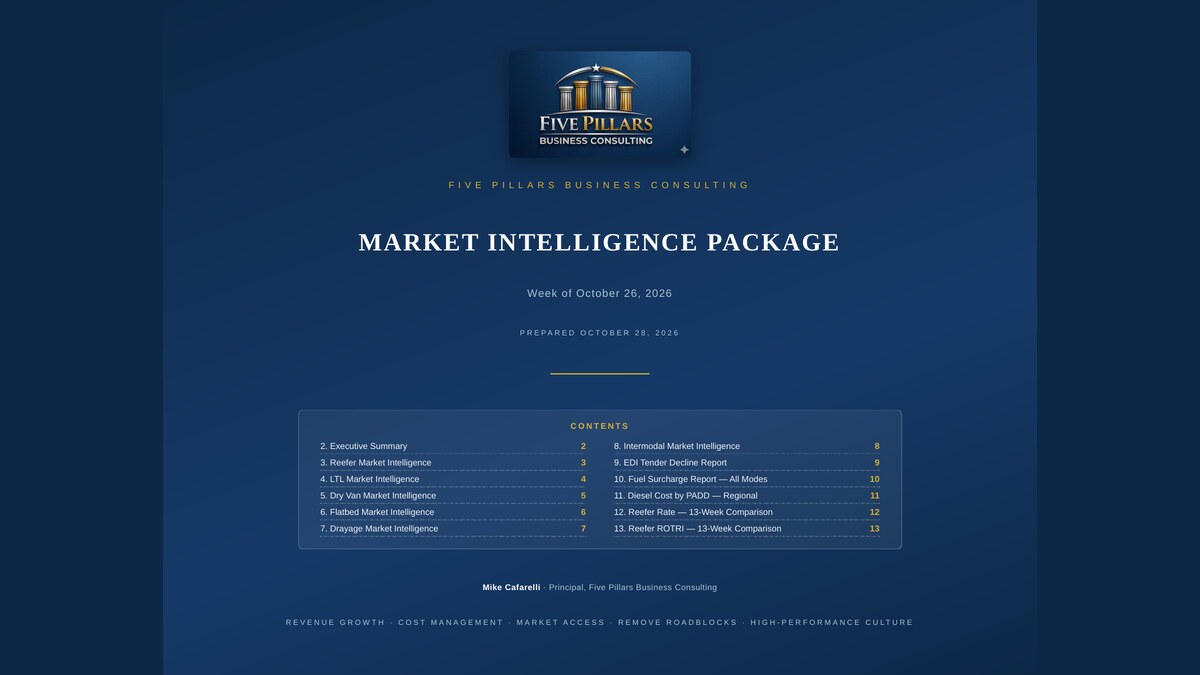
Weekly Freight Market Update: Week of October 26, 2026
The rate decline changed character this week. For a month, falling all-in rates were a fuel artifact while base rates held; this week DAT reports surcharges nearly unchanged — the week-ending 10/24 print still runs off EIA’s $6.179 from 10/12 — so the whole decline came out of linehaul. A 13-page market intelligence package.
View & download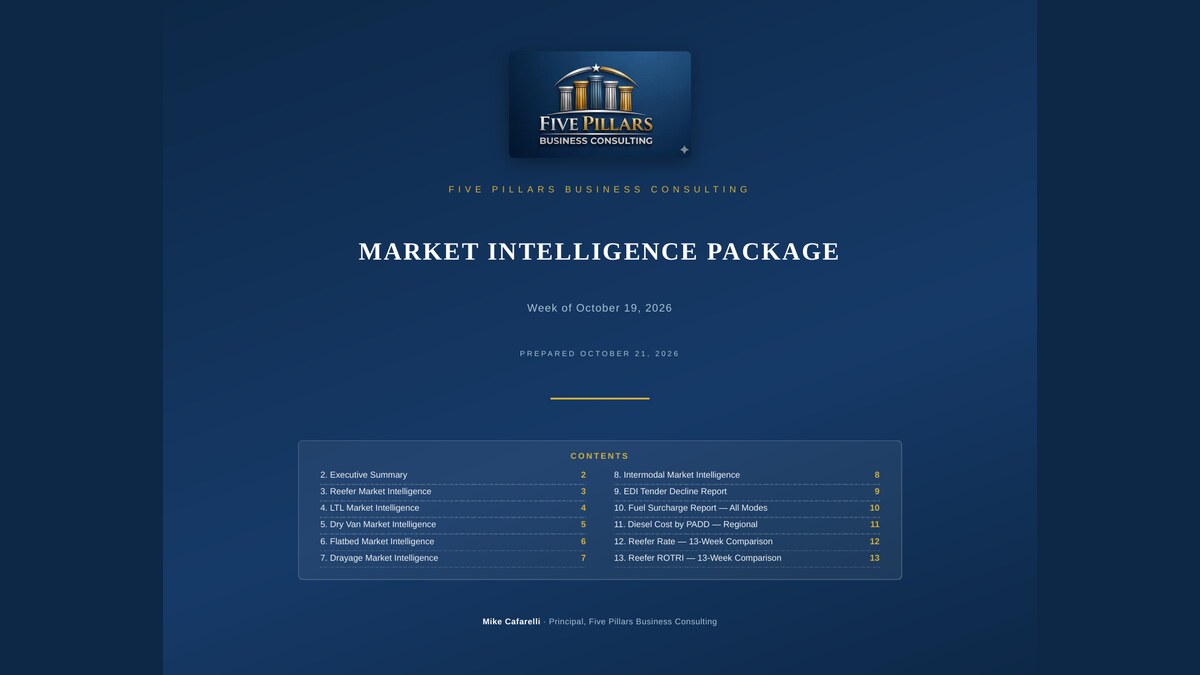
Weekly Freight Market Update: Week of October 19, 2026
Fuel turned around and rail took the quarter. Those are the two facts that reorder every number in this package. A 13-page market intelligence package.
View & download
Weekly Freight Market Update: Week of October 12, 2026
The quarter-end freight surge washed out of the load counts this week — and rates went up anyway. That is the report in one sentence. An 11-page market intelligence package.
View & download