The Five Pillars of Business Consulting
How Five Pillars Business Consulting helps small and mid-market carriers grow revenue, reduce costs, access new markets, remove headaches, and build a culture that sustains performance.
By Michael Cafarelli
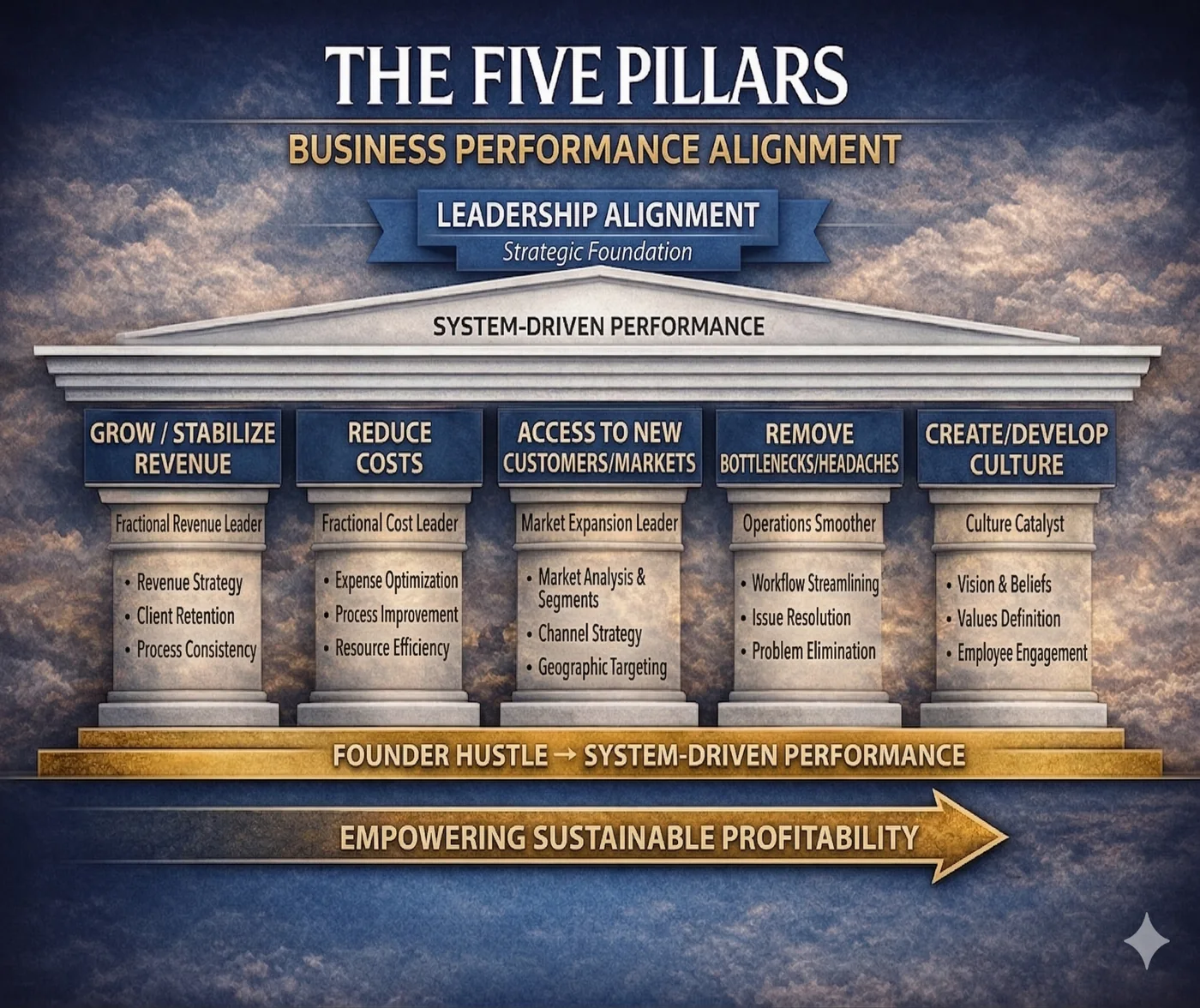
Pillar One — Grow/Stabilize Revenue: Better Freight, Better Customers, Better Math
The first pillar is Grow or Stabilize Revenue, but the word that matters most is not "grow" or "stabilize". It is revenue.
Too many carriers chase top-line growth without demanding enough from the revenue itself. They celebrate wins that add complexity, drain service capacity, create billing disputes, or result in low-quality margins. That kind of growth is dangerous. It feels productive, but it weakens the company over time.
Five Pillars approaches revenue growth as a commercial design problem. The goal is to help carriers earn more from the right work, with the right customers, at the right operating standard.
That starts with revenue visibility. Which customers actually create value? Which lanes produce a high margin after real operating cost is accounted for? Which business lines create strategic advantage? Which relationships are healthy, and which are quietly extracting too much? Many trucking companies cannot answer those questions precisely, which leads to poor decisions.
Once the picture is clear, we help clients improve the commercial model. That may include pricing discipline, service segmentation, customer pruning, account strategy, market selection, or sales process improvement. It may also include turning an owner-led sales effort into a repeatable business development system that others can execute.
Revenue growth also requires operational credibility. In trucking, the sales promise and the operating reality cannot live in separate worlds. A carrier that sells the wrong freight to fill trucks may create downstream pain for dispatch, drivers, billing, claims, and customer satisfaction. We work to align commercial goals with operational capacity so the company can grow without self-inflicted damage.
For small to mid-market carriers, growth opportunities often exist in plain sight. They may be underpricing specialty capability. They may be overly dependent on the spot market when a contract opportunity arises. They may be trapped with the wrong mix of customers because nobody has stepped back to reframe the value proposition. They may be ignoring new verticals that fit the fleet because the organization is too busy reacting to daily issues.
Grow Revenue is about fixing that. It is about creating a more intentional revenue engine. When done well, it improves margins, reduces volatility, and increases the company's value to both customers and future investors.
In the current environment, this pillar matters more than ever. A stabilizing market can give carriers just enough confidence to chase volume again without fixing the math. That is a mistake. The better move is to improve the quality of revenue while the market is still sorting itself out. Carriers that do this well will enter the next stronger cycle with cleaner books, better customers, and more control over their growth path.
That is real revenue growth. Not noise. Not vanity. Not truck-count worship. Real, strategic, sustainable growth.
Pillar Two — Reduce Costs: Margin Is Built One Decision at a Time
If revenue gets the headlines, cost decides how much of it stays in the business.
The current market is brutal on carriers that lack cost discipline. Equipment is expensive. Insurance remains heavy. Fuel can move sharply. Maintenance is unforgiving. Compliance adds labor and administrative burden. Financing terms matter more than they did when money was cheap and freight was easier.
In this environment, cost reduction cannot be handled with broad slogans like "tighten spending." It requires detail. It requires a process. And it requires leadership that knows the difference between cost control and cost panic.
Five Pillars helps carriers reduce costs by identifying where the business leaks money every day. Sometimes the leaks are obvious: poor fuel practices, inconsistent maintenance planning, vendor sprawl, weak routing discipline, excessive downtime, or inflated overhead. Sometimes they are buried in process: duplicate work, slow approvals, avoidable meetings, bad handoffs, billing delays, unclear accountability, or office inefficiency that nobody notices because "that's how we've always done it."
That phrase is expensive.
A disciplined cost program is not about cutting for the sake of cutting. It is about removing waste and increasing control. The right cost improvements strengthen service, reduce friction, and free up leadership time. They also help the company make better strategic decisions because management finally sees where margin is actually being won or lost.
One of the reasons this pillar matters so much now is that many carriers are waiting for rate relief to restore the margin that internal decisions continue to give away. That is not a market problem. That is a management problem. If the business leaks dollars due to poor processes, weak discipline, or outdated habits, a better rate environment may simply mask the issue for a while. It will not solve it.
Reducing cost also builds resilience. A company that knows how to control spend, simplify workflow, improve asset utilization, and maintain service quality under pressure is a company that can endure more and invest sooner. That creates strategic freedom.
Five Pillars brings outside perspective and operator discipline to that work. We help carriers ask better questions, push past legacy assumptions, and create a cost structure that supports growth rather than punishes it. Not every dollar can or should be cut. The goal is to keep the dollars that matter most and eliminate the waste that has been tolerated for too long.
In trucking, margin is rarely saved by one dramatic move. It is built one decision at a time. Better decisions on fuel. Better decisions on maintenance. Better decisions on customer mix. Better decisions on staffing, workflow, reporting, procurement, and service execution. Those decisions compound. And over a cycle, they separate good companies from fragile ones.
Pillar Three — Access to New Customers/Markets: Diversification with Discipline
Carriers rarely get into trouble for lack of effort. More often, they get into trouble because they are overexposed. Too much dependence on one customer, one commodity, one lane pattern, one broker relationship, one season, or one operating model creates fragility. When that one source weakens, the business loses balance.
That is why Access to New Business Markets is one of the Five Pillars.
This pillar is not about random expansion. It is about strategic diversification. It asks a simple but powerful question: where should the company win next, based on its capability, service model, geography, reputation, and economics?
In many small and mid-market carriers, new market access is treated casually. A few scattered calls get made. A salesperson or owner chases whatever opportunity sounds promising. The result is often a patchwork customer base with no coherent strategy. That is not market access. That is wandering.
Five Pillars helps create a sharper plan. We look at what the company does well, what the current market is rewarding, what adjacent opportunities fit the operation, and where new business can be pursued without damaging execution. Sometimes the answer is moving more aggressively into contract freight. Sometimes it is targeting a specialty lane network. Sometimes it is entering a vertical that values service consistency over lowest price. Sometimes it is building relationships in regional markets where density can improve economics. Sometimes it is packaging an operational strength the company has never clearly sold.
New market access also matters because it changes negotiating power. A carrier with only one path to revenue rarely negotiates from strength. A carrier with several viable options can be far more selective. That selectivity protects margin, culture, and customer quality.
This pillar becomes especially valuable in a transition market like the current one. As conditions stabilize, new opportunities open unevenly. Some customers start testing capacity shifts. Some sectors recover sooner than others. Some competitors remain too damaged or too hesitant to pursue new business effectively. That creates openings for operators who are prepared.
But preparation matters. New market access without commercial discipline and operational alignment is dangerous. You can sell the wrong freight just as easily as the right one. That is why the Five Pillars connect this pillar to the others. Growth must make sense. Cost must be understood. Headaches must be managed. Culture must support execution.
When those pieces line up, new business markets can transform a company. They can reduce dependency, improve margin, smooth seasonality, and create a more valuable business. They can also restore confidence to an ownership team that has spent too long reacting to the same narrow set of options.
That is what good diversification does. It does not make the business more complicated. It makes the business more resilient and more strategic.
Pillar Four — Remove Bottlenecks/Headaches: The Hidden Driver of Profit and Scale
Most owners do not realize how much value is trapped inside the headaches they tolerate.
The repeated meeting that never resolves anything. The slow billing cycle. The unclear dispatch-to-billing handoff. The owner has to approve everything. The sales promises operations never agreed to. The manager who holds too much information. The team that solves the same problem every week because nobody has fixed the root cause. The reporting that arrives too late to matter. The constant interruptions that turn leadership into a full-time firefighting job.
These are not minor annoyances. They are economic issues.
Headaches drain management capacity, slow decisions, frustrate good people, damage customer confidence, and quietly erode margin. They also block growth, because a company that is already overloaded cannot expand without multiplying the strain.
This is why Remove Headaches is one of the Five Pillars. It is not soft work. It is one of the fastest ways to improve both performance and quality of leadership.
At Five Pillars, removing headaches usually starts with identifying where friction lives in the business. Not where people say it lives, but where it actually lives. That may be in communication, workflow, accountability, technology use, role design, meetings, approvals, reporting, or customer-facing process. Once the pain points are visible, the next step is simplification.
Simplification is a competitive advantage. Clearer workflows. Better handoffs. Faster information. Cleaner meetings. Stronger role clarity. Fewer unnecessary decisions. Less dependence on heroics. Those changes are not flashy, but they transform the way a company operates.
This pillar matters deeply for founder-led and owner-led businesses. Many small and mid-market carriers are full of good people working around broken systems. The owner becomes the translator, approver, escalator, and final decision-maker. That structure may have worked when the company was smaller, but it becomes a brake on performance over time. Removing headaches often means redesigning the company so leadership can lead and the team can execute.
There is also a human side to this pillar. Good people do not leave only because of pay. They leave because needless friction wears them down. Drivers leave when the operation feels disorganized. Office talent leaves when roles are unclear, tools are weak, and communication is chaotic. Managers disengage when they spend all day cleaning up avoidable issues. Remove enough headaches, and retention improves because work becomes more manageable.
In the current market, this pillar is especially valuable. Carriers do not need more complexity right now. They need a business that can move faster, think more clearly, and execute with less waste. Removing headaches is one of the quickest ways to create that outcome.
The owner feels it first in time and clarity. The customer feels it in consistency. The team feels it in reduced frustration. The P&L feels it in better execution.
That is why this pillar matters. It makes the whole business lighter, sharper, and more scalable.
Pillar Five — Create/Develop Culture: The Difference Between Temporary Improvement and Lasting Performance
Culture is the pillar that many companies say they value, but too few companies truly lead.
In trucking, culture is often confused with friendliness, loyalty, or morale. Those things matter, but they are not enough. Real culture is the pattern of behavior that shows up day after day in decisions, communication, accountability, and standards. It is how the organization acts when the owner is not in the room. It is how people respond under pressure. It is whether the business defaults to ownership or excuses.
That is why Culture Development is the fifth pillar. A carrier can improve pricing, reduce costs, pursue new markets, and simplify workflows, but if the culture does not support disciplined execution, the gains will fade.
The Five Pillars approach culture as a business performance issue. We work with leadership teams to define expectations, improve communication, strengthen accountability, and create a more consistent standard of behavior across the company. That means aligning not only on what people should do, but also on how they should work together while doing it.
Culture matters at every phase of the Cycle of Profitability. In Thrive, it keeps abundance from turning into sloppiness. In Prepare to Endure, it helps teams adapt before pressure rises. In Endure, it determines whether people pull together or turn inward. In Prepare to Thrive, it ensures the company can scale without dragging unresolved habits into a better market.
For small to mid-market carriers, culture often reflects leadership design. If leaders are vague, the culture becomes inconsistent. If leaders tolerate repeated misses, the culture learns to live with them. If leaders communicate poorly, silos appear. If leaders fail to clarify roles, conflict increases. If leaders do not model discipline, the team will not sustain it.
The good news is that culture can be improved when leadership is willing to be honest. That usually begins with seeing the current reality clearly. Where are trust and accountability strong? Where are they weak? What behavior is rewarded? What behavior is ignored? What kind of company is being built through daily habit, whether intentionally or not?
Culture Development is not a one-time speech. It is a management system supported by communication rhythm, meeting quality, role clarity, coaching, consistency, and consequence. It is also one of the most powerful ways to reduce turnover, increase execution quality, and build a company that customers can rely on.
In the current trucking environment, culture matters because stress reveals truth. A weaker market does not create a poor culture; it exposes it. A recovering market does not fix poor culture; it often hides it. That is why leaders must address it directly.
Five Pillars helps owners build a culture worthy of the company they say they want. A culture where people know the standard, understand the plan, respect the customer, own their role, and execute with discipline. That kind of culture is not just healthier. It is more profitable.
More from the blog

Secrets: Ways to Use Today's AI
A 15-second look at RicavaIQ's Secrets: Ways to Use Today's AI, a cross-platform prompt manual with 850 deployable prompts across 17 disciplines and five AI platforms.
Watch
Weekly Market Intelligence: Week of October 5, 2026
Linehaul rose in all three truckload modes for the first time since early September while diesel fell a second straight week. An 11-page market intelligence package on reefer, LTL, dry van, flatbed, tender declines, fuel surcharges, and regional diesel.
View & download
Weekly Market Intelligence: Week of September 28, 2026
The diesel run broke while the freight tape had not yet caught up: all-in rates rose in every mode on a fuel number that had already reversed, and linehaul was flat or down. An 11-page market intelligence package.
View & download